
By all available indications, the White House drafted a face-saving note and handed it, ready-made, to Islamabad. Pakistani Prime Minister Shehbaz Sharif was supposed to then post it in the guise of a plea urging Trump to extend the deadline by two weeks 'to allow diplomacy to run its course'. Trump would then graciously accept Pakistan's 'request' and declare a ceasefire. Sharif dutifully posted the message on X. Except that he, or whoever was handling the account, forgot to delete the tell-tale first line visible in the edit history: 'Draft - Pakistan's PM Message on X'. Prem Panicker's must read blog on the Iran War.

As far as US growth is concerned, he says that the first half of next year is expected to be better than the second half of this year.\n\n

When oil prices are very high, cutting down the subsidy results in sharp increase in oil prices.
Economic boom in countries like India and China and unrest in other parts of the globe are some of the important factors.

According to a RBS report, 'the impact on India's current account deficit should be significant, cumulatively amounting to 1.9 per cent of GDP' provided for the full year FY14 prices for both oil and gold remain at current levels and aggregate volume gold demand remains stable.

The revised projection comes after a 17% rise in the April-June.

Israel and the United States had a plan. Iran punched back. And now the Gulf is reeling, the world is beginning to feel the pain and, as on date, no one in Washington or Tel Aviv appears willing to admit that the punch has landed, notes Prem Panicker, continuing his must-read blog on the war in the Middle East.

Iran has reportedly allowed select "friendly nations" including India and Pakistan limited access to the Strait of Hormuz amid ongoing conflict, easing some energy supply concerns. Here's what the move means for global trade and oil routes.
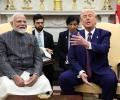
Prime Minister Narendra Modi and US President Donald Trump discussed the West Asia crisis and the importance of keeping the Strait of Hormuz open and secure. They also reviewed progress in bilateral ties and anticipated upcoming deals in the energy sector.

The Confederation of Indian Industry (CII) has proposed a 20-point policy agenda to the finance ministry, including a conflict-linked emergency credit line guarantee scheme and tax rationalisation on energy inputs, to support MSMEs, exporters, and energy-intensive industries affected by the ongoing West Asia war.

India's plans to ration the consumption of liquefied natural gas (LNG) and liquefied petroleum gas (LPG) - in response to reduction in their import owing to war in West Asia - may fall short of what is needed to meet domestic needs.

Let us start with ourselves. If we can reduce our LPG consumption by half, the problem is solved. Reduce wastage. Alter eating styles. Diversify methods of food preparation, suggests Vice Admiral Biswajit Dasgupta (retd).

Trump may strike. He may announce productive talks and extend again. He may do both at the same time. Iran will not open the Strait on someone else's terms, so no matter what happens, that problem will remain unsolved. And the IRGC will still be collecting its $2 million toll from every ship bold enough to ask permission to pass.
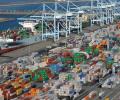
'The immediate impact for India will be very minimal as the share of Venezuela in our total overseas production is very low.'

...is a way out, notes Prem Panicker in his must read blog on the Iran War. What the indefinite extension produces is a prolonged condition of not-war-not-peace, in which oil markets cannot stabilise, Asian refineries cannot plan, European governments cannot stop subsidising consumption they cannot afford, and the next flashpoint -- a seized tanker, a miscalculated drone strike, a Truth Social post that claims too much -- is one news cycle away.
The threat of war in Iraq and fear of terrorism in the United States and Britain pushed oil prices to near two-year highs on Thursday, drove investors into the safety of bonds but battered stocks and the dollar.
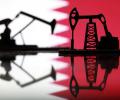
Qatar, India's largest supplier of imported natural gas, has declared force majeure on deliveries following a halt in production in the wake of an Iranian drone strike -- a disruption that has led to a cut in supplies to Indian industry by up to 40 per cent, sources said.
Several non-banking financial companies (NBFCs) are observing an increase in early-stage delinquencies within their micro, small and medium enterprises (MSME) loan portfolios, primarily driven by supply chain disruptions and escalating raw material costs exacerbated by the ongoing conflict in West Asia.
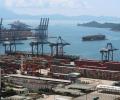
With the Iran war escalating sharply and crisis deepening in the global energy market, India on Monday unveiled a coordinated plan to support exporters and shippers caught in the fallout.

The measures announced by it risk backfiring, disrupting the foreign exchange market, and intensifying the very pressures they seek to contain, with broader consequences for the economy points out Rajeswari Sengupta.
Expressing concern over the impact of rising crude oil prices on Indian economy, Prime Minister Manmohan Singh on Monday said it can have adverse consequences for the economy. "We cannot allow the subsidy bill to rise any further," Singh said and appealed to all the political parties to adopt a wider consensus on the pricing issue.

India could save $1 billion in crude oil imports annually if the country switches 10 per cent of its diesel usage in the transport sector to liquefied natural gas.

US President Donald Trump and Russian President Vladimir Putin discussed the Iran conflict and its impact on global energy supplies during a phone call.
Oil prices fell from their two-year highs on Tuesday, as pressure mounted against an immediate attack on Iraq, lessening fears of a possible disruption of oil supplies from the world's eighth-largest exporter.
US President George W Bush said that oil prices are rising as the economies of India and China are also growing.

'There is no shortage of fuel whatsoever.' 'India is stock surplus as far as petrol and diesel are concerned.'

Financials were the top losers while oil shares also declined amid weak crude oil prices.

One of the reasons is that the retail prices are not bench-marked to crude but their respective international benchmark prices.
BJP leader Mithun Chakraborty has criticised the West Bengal government over high fuel taxes and alleged security lapses, particularly concerning women's safety and border control.

The ongoing conflict involving the United States, Israel, and Iran intensified sharply with attacks on critical energy infrastructure across the Gulf, even as US President Donald Trump said he had cautioned Israeli Prime Minister Benjamin Netanyahu against targeting Iran's key South Pars Gas Field.

India's economy is projected to maintain growth above 7 per cent in 2026-27 (FY27), supported by strong domestic consumption and investment, even as global growth faces risks from geopolitical tensions, according to industry body Assocham.
The country's fiscal deficit, as a percentage of GDP, would be wiped out if the crude oil price, as measured with the Indian basket, touch $80 per barrel.

From just 0.2 per cent before the Russia-Ukraine war to now accounting for 35-40 per cent of total crude imports, India's reliance on Russian oil has surged -- drawing fresh scrutiny with US President Donald Trump announcing a penalty on top of a 25 per cent tariff, or tax, on all goods going to the US.
Amidst soaring oil prices posing a threat to the world economy, the United States has said there is "no magic wand" to solve the problem overnight.

For that to happen America does not have to lose. It only has to do the right thing, asserts Aakar Patel.
Replying to questions on losses to Air India, civil aviation minister Praful Patel said the rally in international crude oil prices that touched $147 a barrel in July 2008, hit Indian carriers by Rs 10,000 crore (Rs 100 billion) in jet fuel bill. Air India loses are a result of high jet fuel prices and fall in air traffic following global economic slowdown, he said. "There are (also) systematic issues which need to be corrected."

The clock on the ceasefire is running out. But everyone's already whispering about round two, possibly as soon as this weekend.

There are roughly 2,000 ships stranded in the Persian Gulf, carrying more than 20,000 seafarers, according to the International Maritime Organisation, as quoted by The Wall Street Journal.

The 'rescue' operation occurred within kilometres of Iran's underground tunnel complex at Isfahan, assessed by the IAEA and US intelligence as holding a substantial portion of the country's 60 per cent enriched uranium stockpile. Retired senior US military officers have highlighted that the mission's footprint -- hundreds of special operators, multiple heavy-lift aircraft deep inside Iran -- appears outsized for recovering a single airman. Prem Panicker continues his must read blog on the Iran War.
